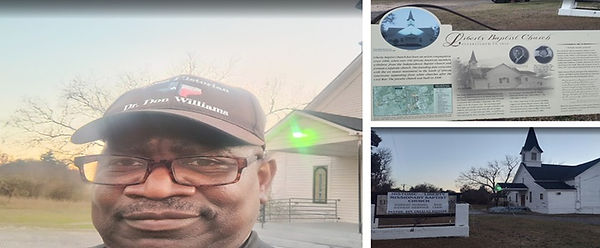
Texas History in Real Time:
A walk through time with Dr. Don Williams
Join Dr. Don Williams for a captivating historic walk through Texas, where you'll experience rich tapestry of the state's past. Discover fascinating stories and events that have shaped Texas history in real time. This immersive journey will leave you with a deeper appreciation for the Lone Star State's vibrant heritage.
A Historian’s Visit to Independence, Texas
Hello Texas,
I want to talk about the town of Independence, a place many people pass through quickly, and in doing so, miss what truly matters. I have watched numerous videos of Independence that treat it as a drive-by destination. That approach does the town a disservice. In reality, this small community holds more documented Texas history than many towns five times its size.
When discussing universities in Texas, Baylor University is rightly recognized as the oldest continuously operating university in the state. It is true that Southwestern University traces its origins to Rutersville College (1840), which technically predates Baylor. However, Rutersville College ceased operations around 1856 due to multiple challenges. The rise and permanence of Baylor University likely played a role in that outcome, though readers should examine the historical record and draw their own conclusions.
I have personally visited the site of Rutersville College. Today, the location contains little beyond two historical markers and two cemeteries. While modest in appearance, the site remains significant as part of Texas’s early educational history.
Independence is the original home of Baylor University, where both the male and female campuses were established, separate but close. The distance between the two sites is approximately six-tenths of a mile from front gate to front gate. Visitors can still walk both locations, read numerous historical markers, and gain a real sense of what once stood there. This is my preferred method of research. Putting boots on the ground matters.
T
The former male campus includes replicas of items from the original school and marks the original gravesite of Baylor’s founder, Robert Emmett Bledsoe Baylor. He is no longer buried there. His remains were later moved to the campus of University of Mary Hardin-Baylor, where he is interred in an above-ground monument that resembles a stone bench behind the educational pillars near the main building. I have visited both burial locations multiple times. Seeing his current burial arrangement in the open can feel unusual, but that is where he rests today.
Anyone truly interested in history should take time to read every historical marker and poster throughout Independence. These displays include photographs, diagrams, and detailed explanations of buildings and events long gone. My recommendation as a historian is simple: read everything. If you do not, you will almost certainly need to return to see what you missed. Even after reading all the material carefully, I still notice new details on repeat visits.
Approximately one mile away is the former female campus of Baylor University, where the original stone pillars still stand as they did in the mid-1840s. Though the buildings are gone, the site remains powerful and well-documented.
Independence is far more than Baylor’s birthplace. It was also home to Sam Houston and his family. Just two or three blocks from the original Baylor campus stands the white, two-story Houston home, still visible today. Across the street are the church and cemetery associated with the Houston family.
A return visit to the Houston–Lea Family Cemetery allowed me to document the grave layout precisely. When facing the front of the cemetery, the graves of Aunt Lethe and Aunt Eliza, two Black women associated with the Lea–Houston household, are positioned together on the left side of Margaret Lea Houston. Margaret’s
mother, Nancy Moffitt Lea, is buried to her daughter’s right. An infant child of Mr. and Mrs. W. L. Williams is located toward the center rear of the plot. Although an original burial vault stands nearby, the clearly marked grave of Nancy Moffitt Lea confirms she was not permanently interred there. Given that Nancy died in February 1864 and Margaret followed nine months later, the final arrangement likely reflects deliberate family decisions made during a short and difficult period. The physical placement of the graves confirms that Aunt Eliza and Aunt Lethe were intentionally buried beside Margaret Lea Houston, an important fact often overlooked but preserved unmistakably in stone.
Another important burial ground is Independence Cemetery, located toward the back of town. Among those buried there is Sam Houston Jr., the oldest son of Sam Houston. He served the Confederacy, a fact that complicates his legacy but does not erase his place in Texas history.
Despite claims to the contrary, Independence is not a ghost town. I personally observed well over one hundred residents, possibly closer to two hundred. The population includes White, Black, and Hispanic families, many living near the church and cemetery areas. Videos suggesting the town is empty are simply incorrect.
One of the most rewarding experiences during my visit was time spent in the church museum. There I found extensive documentation of Independence’s history, from Baylor University to the daily lives of the Houston family. Inside the church are pews once used by Sam Houston and his family, tangible reminders of their presence. The museum also helped me locate Independence Cemetery, where after more than ten years of searching, I finally stood at the grave of Sam Houston Jr.
Independence also includes a historic African American community and an African American church located on the same street as the church attended by the Houston family, a detail that speaks volumes about the town’s layered history. There are posters depicting the history of the former enslaved African Americans as they worked in the cotton fields of the town.
There are posters depicting the history of the former enslaved African Americans as they worked in the cotton fields of the town.
Finally, I visited the baptismal site of Sam Houston, located approximately 1.8 miles from the original male Baylor campus, near a creek that served as a traditional baptismal location for the community.
I hope this account of my historical tour of Independence, Texas, is both informative and accurate. Everything presented here is based on direct observation, documented sources, and repeated site visits. Independence rewards those who slow down, read carefully, and walk the ground where Texas history actually happened.
In closing, remember this: the lack of history creates a mystery. Thank you for taking this journey with me. Have a wonderful day, and may God bless you in the name of Jesus.